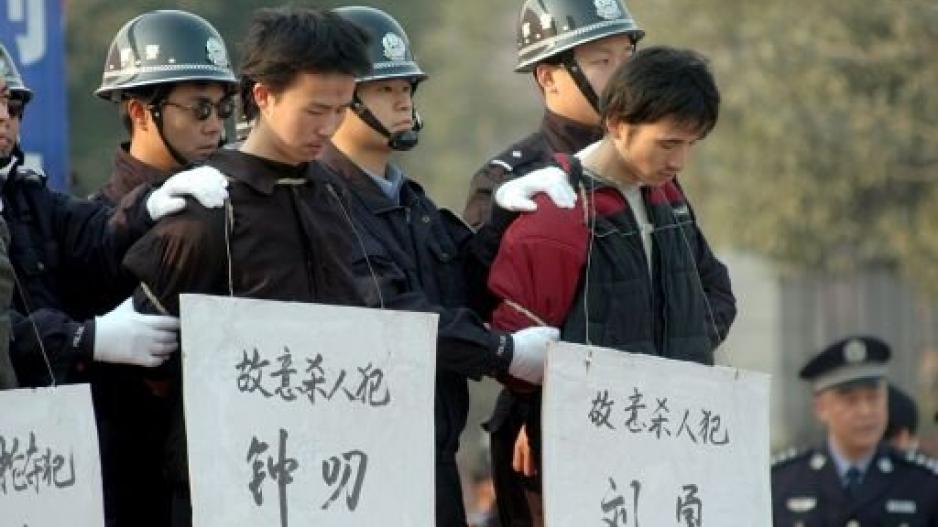
Amnesty International's report on the reduction of the death penalty in the world in 2017 leaves little hope, but does it also record the international trend? It's relevant, it's the answer of Holovatzin Popola, the organization's advisor for the end of sentences. The decrease, he says, was recorded in 3 countries occupying the first places in the statistical scale, Iran, Saudi Arabia and Pakistan. In Iran, which has recently experienced riots and protests, executions have fallen by 11%, while in Pakistan the decline has fallen to 31%.
China is a black spot
"For example, in Iran, the reduction in executions is due to criminal justice reform related to drug crime," he said. "It is difficult for Pakistan and Saudi Arabia to find specific reasons. The executions, 305 in the first and 158 in the second that took place in 2016, in 2017 decreased ".
The organization's report for 2017 has a black spot, China, because there is no information on the number of executions there. The country is still in the first place, but the real dimensions of the problem are not known, because the relevant information has been reduced to a seven-seal secret. Excluding China, 84% of executions take place in four countries: Iran, Saudi Arabia, Iraq and Pakistan. "In Iraq, the death penalty is a means of revenge as a response to terrorist acts," said Olovatzin Popola. "Dozens of suicide bombers were executed last September."
"It does not protect victims"
Amnesty International's 2017 report proposes the following statement by UN Secretary-General Antonio Guterres: the death penalty has little to do with protecting victims or preventing crime. "There is little convincing evidence that the perpetrators are ultimately prevented from being severely punished," Popola added. "It appears that in countries where the death penalty was abolished, such as Canada, the crime rate in 2016 was as high as in 1976, the year the death penalty was abolished." The next step is to limit the use of the death penalty in countries where executions take place, Popola said. And this can be done through an official moratorium, where the end of sentences will be changed to life.
However, in general, the numbers for 2017 leave a glimmer of hope that the world is at a turning point and that the abolition of this inhuman and extremely barbaric act is a matter of time.